Uniteee Violence and Incarceration Prevention
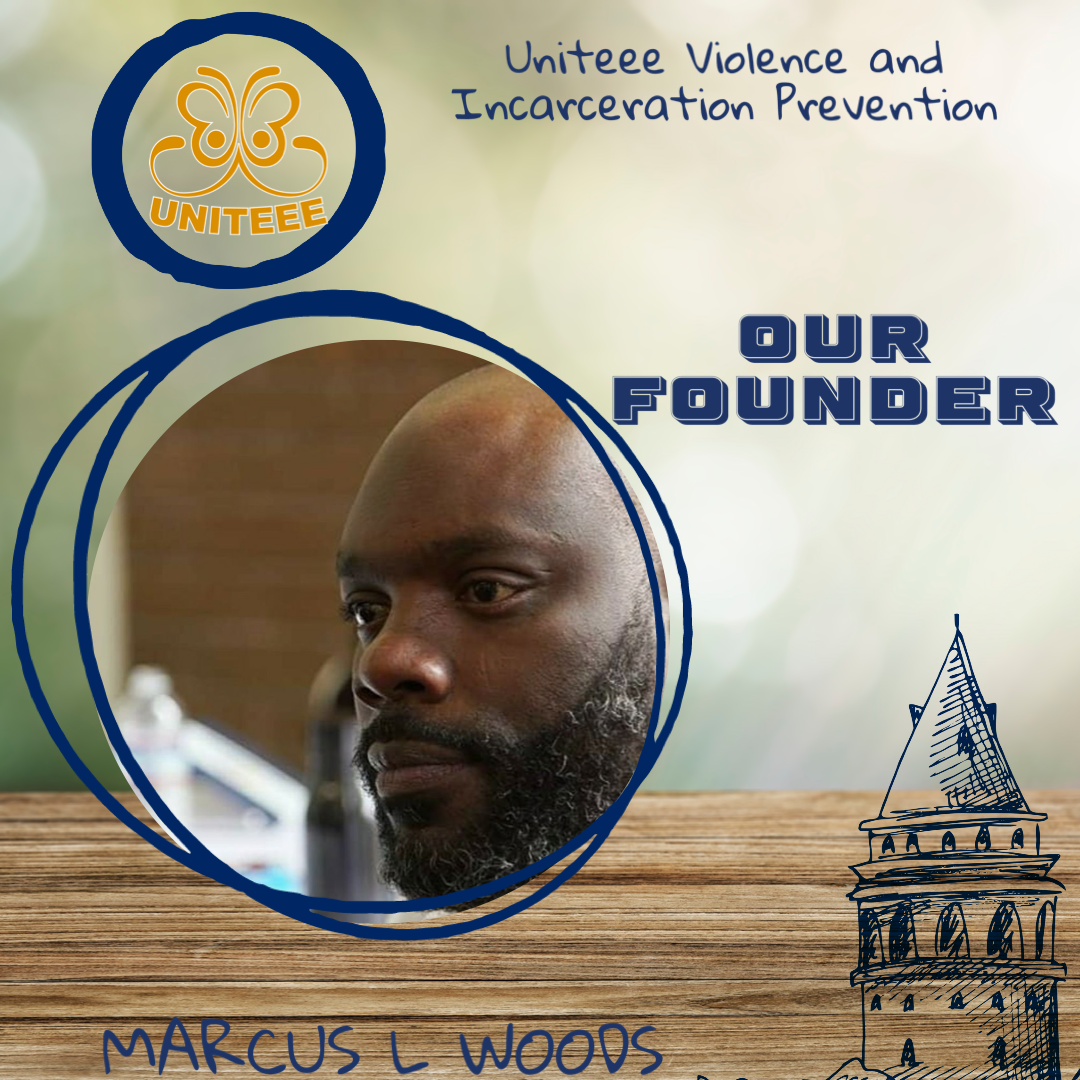
In 2012, Marcus L. Woods wrote three letters on a piece of paper: E, E, E.
These three letters represented the foundation of everything UNITEEE would become. The first E stood for Empowerment—the recognition that young people must be given power over their own lives and futures. The second E stood for Education—not just academic learning, but the kind of transformative knowledge that changes how people see themselves and their possibilities. The third E stood for Excellence—the standard to which every young person should be held and supported to achieve.
At the time, Marcus was still navigating his own reentry after 17 years of incarceration. He had been arrested at age 17 for being in a carjacked car—a crime he did not commit—and had refused to inform on those who did. The system waited until his 18th birthday to sentence him as an adult to 19 years. Later, the prison sent a letter claiming there had been a mistake and had him resentenced under an even harsher law, extending his time. Upon release, his property was destroyed—poetry and documents he had written over the years, poured over with coffee by correctional staff.
But they could not destroy what was in his mind. They could not destroy his understanding of what young people need to avoid the path he had been forced down. They could not destroy his commitment to building something better for the next generation.
Those three letters—Empowerment, Education, Excellence—became a curriculum. That curriculum became workshops. Those workshops became a movement. And that movement, over 14 years, became UNITEEE Violence and Incarceration Prevention, a registered 501(c)(3) nonprofit organization with a proven track record of transforming lives and preventing violence in high-risk communities.
Today, UNITEEE stands as a trademarked brand—a legal recognition that what began as three letters scrawled by a man rebuilding his life after 17 years of wrongful incarceration has become something protected, something owned, something that cannot be taken the way his poetry once was. For Marcus, the trademark is more than doing paperwork. It is proof that the identity he built from nothing now belongs to him and to the mission, permanently and irrevocably.
The framework itself did not stay still. What began as E³ evolved into BUILDING B.R.I.D.G.E.S.—Building Relationships, Inclusion, Dialogue, Growth, Empathy, Safety—a rebrand born not from abandoning the original vision but from sharpening it, formalizing 14 years of proven work into language that funders, schools, and justice systems could recognize and trust. Alongside it, Marcus built the ARISE rubric—Accountability, Respect, Integrity, Self-Awareness, Empowerment—a way to measure not just attendance, but transformation. What could not be measured in prison—growth, dignity, change—he made measurable on the outside.
He did not build alone. Board members and volunteer facilitators carried the work into rooms Marcus could not always reach himself, while informal partnerships with reentry networks like TimeDone and probation offices opened doors into the very institutions that had once closed around him—this time, as an invited guide instead of a confined body.
The work also became a place. Born Guilty—an apparel line, a six-session curriculum, a community space, an education program—gave the thesis behind Marcus's life a name and an understanding that systems assign guilt by identity long before any young person ever stands before a judge. The workshop journey it structured for —Verdict, Science, Institution, Four Domains, Reclamation, Built Free—mirrors his own path, in reverse: a system once wrote him a verdict; now he writes a way out of one, for someone else.
Fourteen years. Over 500 justice-impacted youth. Schools, community centers, and juvenile facilities across California. A curriculum that started as three letters is now a system tracking real outcomes, a strategic plan reaching into 2030, and a trademarked name carried by a movement larger than the man who founded it—though it never forgets him.
Marcus L. Woods is still writing. Now, instead of poetry poured over with coffee, he writes frameworks, curricula, and futures—for young people the system has not yet finished failing, and might, because of him, never fully break.